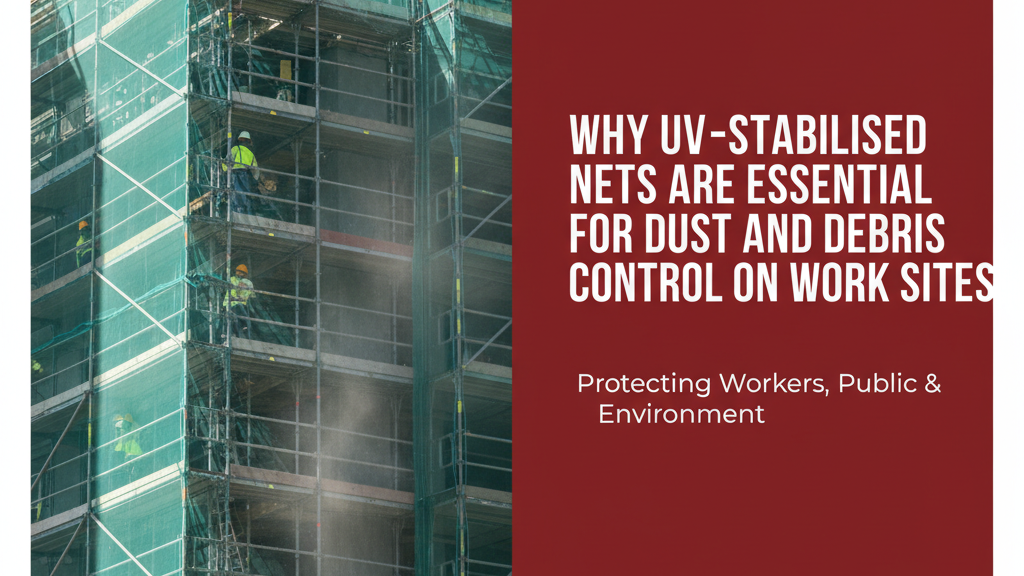
The Growing Need for Dust and Debris Control
Construction and work sites face significant challenges in managing dust and debris, especially in India’s diverse climatic conditions. Uncontrolled particulate matter can lead to:
- Reduced visibility for workers and nearby traffic
- Respiratory health risks for labourers and surrounding communities
- Premature wear of machinery and equipment
- Compliance violations under environmental regulations
Temporary containment solutions must withstand monsoons, intense UV exposure (up to 12 hours daily in peak summer), and wind speeds exceeding 50 km/h in some regions.
What Are UV-Stabilised Nets?
These high-density polyethylene (HDPE) or polypropylene mesh barriers incorporate:
- Carbon black or specialised UV-inhibiting additives that slow photodegradation
- Knitted or woven construction maintaining 35-85% opacity based on application
- Tensile strengths ranging from 180N to 400N for wind resistance
How UV-Stabilised Nets Protect Work Sites
Properly installed debris netting serves multiple protective functions:
| Hazard | Protection Mechanism |
|---|---|
| Dust dispersion | Reduces airborne particles by 60-85% when combined with water sprinkling |
| Falling debris | Contains materials up to 5kg/m² impact load (varies by mesh density) |
| Unauthorised access | Acts as visual barrier with optional reinforcement for security |
Benefits of Using UV-Stabilised Nets on Construction Sites
Enhanced Durability in Harsh Conditions
UV-stabilisation extends functional lifespan from months to years by:
- Maintaining fibre integrity despite 45-50°C summer temperatures
- Resisting embrittlement from monsoon humidity (70-95% RH in coastal areas)
- Sustaining performance through multiple project phases
Cost-Effective Debris Management
Compared to solid barriers or repeated replacement of standard nets:
- 20-30% lower lifecycle costs over 3 years
- Allows natural ventilation, reducing supplementary dust control needs
- Reusable across multiple projects with proper storage
Compliance with Safety Regulations
Meets key provisions of:
- IS 14462 for plastics in construction applications
- Construction workers’ safety guidelines under the Building and Other Construction Workers Act
- Municipal bylaws on dust suppression in 60+ Indian cities
Choosing the Right UV-Stabilised Net for Your Project
Select nets based on these site-specific factors:
| Factor | Guideline |
|---|---|
| Exposure duration | 6+ months: Opt for 10% UV-stabilised compounds instead of standard 2-3% |
| Debris type | Heavy materials require 200+ gsm weight and reinforced edges |
| Site wind conditions | High-wind areas need smaller mesh (≤20mm) with 300N+ tensile strength |
Lighter green or blue nets offer better visibility control than black variants in residential areas.
Installation Tips for Maximum Effectiveness
- Space anchor points every 1.5-2m for standard 3m height installations
- Overlap adjoining sections by ≥30cm with UV-resistant ties or hog rings
- Extend ground contact using sandbags or buried edges (15-20cm depth)
- Check tension weekly – sagging reduces efficiency by up to 40%
FAQs About UV-Stabilised Nets
How long do UV-stabilised nets typically last?
With proper installation, expect 3-5 years of service life in tropical climates, though monthly inspections are recommended after year 2.
Can these nets be recycled?
HDPE-based versions are recyclable (ISI mark indicates material composition), but contaminated nets may require specialised processing.
Do they require any maintenance?
Periodic cleaning with water jets maintains airflow and visibility; avoid high-pressure washing within 30cm of edges.