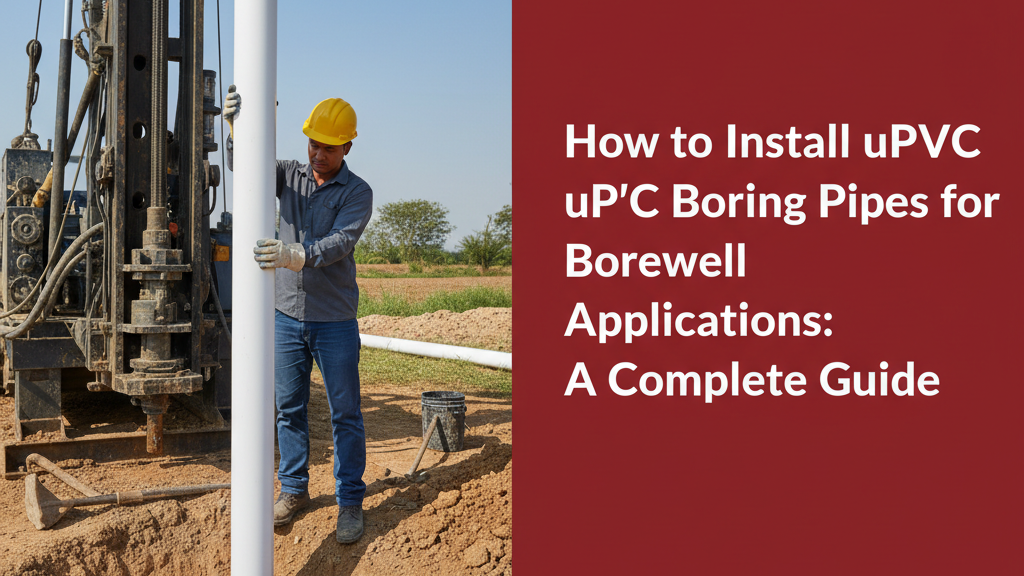
Introduction to uPVC Boring Pipes for Borewells
uPVC boring pipes have become the preferred choice for borewell applications across India due to their durability, corrosion resistance, and ease of installation. Unlike traditional metal pipes, uPVC pipes resist rust and chemical reactions with groundwater, ensuring cleaner water supply and longer lifespan. Their lightweight nature makes them particularly suitable for deep borewell installations where heavy materials would pose handling challenges.
Benefits of Using uPVC Boring Pipes
- Corrosion resistance: Unlike metal pipes, uPVC won’t rust or react with minerals in groundwater, maintaining water quality.
- Lightweight: Weighing about 1/6th of equivalent steel pipes, they’re easier to handle during deep borewell installations.
- Chemical stability: Resistant to acids, alkalis, and salts commonly found in Indian groundwater conditions.
- Smooth interior: Minimises friction loss, improving water flow efficiency by up to 20% compared to corroded metal pipes.
- Longevity: Properly installed uPVC boring pipes typically last 25-30 years in borewell applications.
Materials and Tools Required
Before beginning your borewell installation, gather these essentials:
- uPVC boring pipes (typically 90mm or 110mm diameter for residential borewells)
- uPVC couplings with rubber seals
- Pipe cutter or hacksaw
- Emery paper (for deburring pipe ends)
- Threaded borewell shoe (strainer)
- Silicon lubricant
- Measuring tape
- Spirit level
- Lowering clamps/rope
Step-by-Step Installation Guide
Preparing the Borewell Site
Begin by ensuring the borewell drilling is complete and the hole is clear of debris. The diameter should be at least 50mm wider than your pipe assembly to allow proper gravel packing. Mark the pipe lengths sequentially to maintain orientation during assembly.
Assembling the uPVC Pipes
- Cut pipes to required lengths using a pipe cutter, ensuring square cuts.
- Deburr cut ends with emery paper and clean both pipe ends and coupling sockets.
- Apply silicon lubricant to the rubber seals and pipe ends.
- Insert pipes into couplings with a twisting motion until fully seated.
- Attach the borewell shoe to the first pipe section.
Lowering the Pipes into the Borewell
Using lowering clamps or strong ropes:
- Slowly lower the assembled pipe string into the borewell, maintaining alignment.
- Add pipe sections sequentially, checking each joint’s seating before continuing.
- Maintain steady descent speed to prevent pipe separation or impact damage.
Securing and Sealing the Pipes
Once fully lowered:
- Pack gravel around the pipe assembly (typically 4-6mm size) to stabilise the formation.
- Seal the borewell head with a cement collar to prevent surface water contamination.
- Install a sanitary seal at ground level to complete the installation.
Common Challenges and Solutions
| Challenge | Solution |
|---|---|
| Pipe separation during lowering | Use proper lowering clamps and verify each joint is fully seated before proceeding |
| Difficulty inserting pipes into couplings | Ensure proper lubrication and clean, deburred pipe ends |
| Alignment issues in deep borewells | Use a spirit level periodically and adjust lowering speed |
| Post-installation leaks | Verify proper gravel packing and consider using solvent cement for critical joints |
Maintenance Tips for Longevity
- Annually inspect the borewell head seal for cracks or deterioration.
- Monitor water output – sudden changes may indicate pipe blockage or joint failure.
- Avoid using harsh chemicals for borewell cleaning that could damage uPVC.
- Keep records of pipe installation depth and specifications for future reference.
FAQs About uPVC Boring Pipe Installation
Can uPVC pipes handle the pressure in deep borewells?
Quality uPVC boring pipes are designed for working pressures up to 10kg/cm², suitable for most residential borewell depths up to 200m. For deeper installations, consult the manufacturer about pressure ratings.
How do I know what diameter pipe to use?
90mm pipes suit most 2-3HP pumps, while 110mm is better for 5HP pumps. Always match pipe ID to pump specifications.
Is solvent cement necessary for joints?
Rubber-sealed couplings are typically sufficient, but solvent cement can provide extra security for critical joints or unstable formations.
Can existing metal borewell pipes be replaced with uPVC?
Yes, though the process requires careful extraction of old pipes. Often simpler to drill a new borewell adjacent to the old one.