Introduction to HDPE and uPVC Pipes
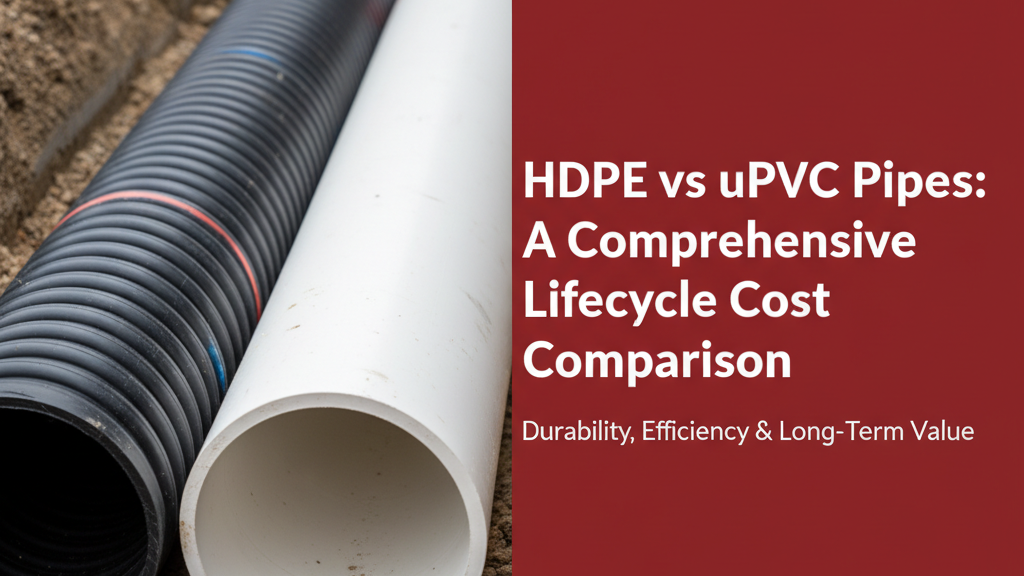
When planning water supply or drainage systems, two popular piping materials dominate the Indian market: HDPE (High-Density Polyethylene) and uPVC (unplasticised Polyvinyl Chloride). Both offer distinct advantages in terms of cost, durability and ease of installation. But which one provides better value over a 10-30 year period? A lifecycle cost analysis considers not just the initial price tag, but also installation efficiency, maintenance demands, environmental factors and replacement cycles under typical Indian conditions.
Key Differences Between HDPE and uPVC Pipes
These thermoplastic pipes share corrosion resistance and lightweight properties, but their material science leads to divergent performance profiles:
- Flexibility: HDPE bends easily (25× pipe diameter radius), while uPVC requires elbow joints
- Temperature range: HDPE handles -40°C to 60°C vs uPVC’s 0°C to 45°C comfort zone
- Jointing methods: HDPE uses heat fusion (butt/electrofusion), uPVC relies on solvent cement
- UV resistance: uPVC has marginally better sun tolerance without stabilisers
Material Composition Breakdown
| Property | HDPE | uPVC |
|---|---|---|
| Base Material | Petroleum-derived ethylene | Chlorinated hydrocarbon polymer |
| Additives | 2-3% carbon black (UV protection) | Lead/Tin stabilisers (varies by brand) |
| Density | 0.93-0.97 g/cm³ | 1.3-1.45 g/cm³ |
Note: Both materials meet IS 4984 (HDPE) and IS 13592 (uPVC) standards for potable water applications when bearing ISI marks.
Durability and Performance Factors
Indian conditions test pipes with monsoons, soil movement, and temperature extremes:
- Impact resistance: HDPE withstands 4-5× more blunt force than uPVC before cracking
- Chemical resistance: uPVC handles acidic soils better; HDPE resists hydrocarbons
- Flow efficiency: HDPE’s smooth bore maintains >95% flow rate over decades versus uPVC’s 85-90%
- Earthquake performance: HDPE’s flexibility prevents joint failures during tremors
Installation Cost Analysis
Project costs vary by diameter and terrain, but typical norms for 110mm pipes:
| Factor | HDPE | uPVC |
|---|---|---|
| Material Cost (₹/metre) | 120-150 | 90-110 |
| Joints Needed/100m | 3-4 (fusion) | 8-10 (cement) |
| Trench Width | Pipe OD + 100mm | Pipe OD + 200mm |
| Installation Time | 30% faster | More alignment checks |
HDPE’s fusion welding requires trained operators, while uPVC assembly has lower skill barriers but higher joint failure risks.
Longevity and Maintenance Costs
Total ownership costs emerge over decades:
- Expected lifespan: HDPE (50-70 years) vs uPVC (35-50 years) in buried conditions
- Maintenance events: uPVC systems average 2-3 joint repairs per decade versus HDPE’s 0.5
- Replacement cycles: uPVC may need one full replacement within HDPE’s service window
- Leak rates: Studies show HDPE networks lose <5% water versus uPVC’s 8-12%
Environmental Impact Considerations
Sustainability comparisons must account for:
- Embodied energy: uPVC production consumes 25% less energy than HDPE
- Recyclability: Both are 100% recyclable, but HDPE recycling rates run higher (60% vs 45%)
- Carbon footprint: HDPE pipes generate 1.8kg CO2/kg versus uPVC’s 2.3kg
- Water contamination risks: Poor-quality uPVC may leach stabilisers; HDPE is inert
Case Studies: HDPE vs uPVC in Real Applications
Urban Water Supply (Kolkata): A 2018-2023 study showed HDPE networks had 37% lower maintenance costs versus uPVC despite 18% higher initial investment.
Agricultural Drainage (Punjab): uPVC performed adequately in stable soils, but HDPE outlasted it by 9 years in areas with significant clay expansion.
Industrial Effluent (Gujarat): HDPE resisted chemical attacks from dyeing units where uPVC joints failed within 5 years.
Conclusion: Assessing Long-Term Value
While uPVC wins on upfront costs, HDPE generally delivers better lifecycle economics for projects where:
- The terrain has soil movement or seismic risks
- Systems require minimal downtime for repairs
- Water conservation is prioritised (leak reduction)
- Total cost of ownership matters more than first costs
For small-scale, stable-ground applications with budget constraints, uPVC remains a viable choice – especially when using ISI-marked pipes with robust joining practices. Material selection should align with the project’s specific technical and financial parameters.