Introduction to Piping Standards
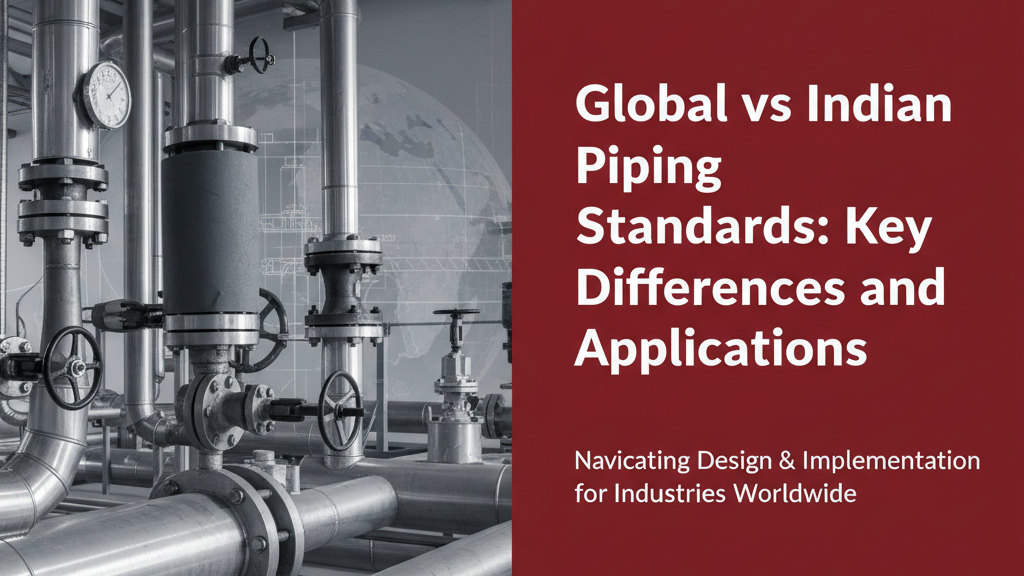
Piping standards exist to ensure safety, durability, and performance across water supply, drainage, and industrial applications. Globally and in India, these standards govern materials, dimensions, testing protocols, and installation practices. While international standards like ASME and ISO are widely recognised, India’s Bureau of Indian Standards (BIS) tailors specifications to local environmental and usage conditions.
Global Piping Standards Overview
Three major organisations define global piping standards:
ASME Standards
The American Society of Mechanical Engineers (ASME) develops codes like ASME B31.1 (power piping) and B31.3 (process piping). These emphasise:
- Pressure ratings for high-temperature industrial applications
- Detailed welding and inspection procedures
- Material grades compatible with corrosive fluids
ASTM Standards
ASTM International specifies material properties, with common standards including:
- ASTM D3035 for PVC pipe dimensions
- ASTM F714 for HDPE pipe pressure ratings
- Testing methods for impact resistance and hydrostatic design basis
ISO Standards
The International Organization for Standardization (ISO) provides harmonised benchmarks such as:
- ISO 4427 for PE water supply pipes
- ISO 1452 for uPVC piping systems
- Global acceptance for export-oriented projects
Indian Piping Standards Overview
BIS Standards
The Bureau of Indian Standards (BIS) adapts global norms to India’s climate and infrastructure needs. Key standards include:
- IS 4985 for HDPE pipes (aligned with ISO 4427 but with modified test parameters for tropical conditions)
- IS 14151 for multi-layer composite pipes
- IS 14846 for uPVC plumbing systems, accounting for hard water and monsoon stresses
BIS certification mandates factory audits and product testing by approved labs, ensuring compliance with Indian safety margins.
Comparison of Global and Indian Standards
Material Specifications
| Parameter | Global (ASTM/ISO) | Indian (BIS) |
|---|---|---|
| UV Stabilisers | Optional for buried pipes | Mandatory due to high solar radiation |
| Pipe Wall Thickness | Based on pressure class | Often thicker to accommodate manual handling |
Design and Testing Requirements
- Hydrostatic Tests: ASME requires 1.5x working pressure; BIS specifies 2x for potable water pipes
- Jointing Methods: ISO standards prefer electrofusion for HDPE; BIS also recognises solvent welding for uPVC in low-pressure applications
Certification Processes
While ISO and ASME rely on manufacturer self-declaration with periodic audits, BIS requires:
- Quarterly product sampling
- Marking with standard number and licence
- Local testing for chemical resistance and load-bearing capacity
Choosing the Right Standard for Your Project
Consider these factors when selecting piping standards:
- Location: Coastal or high-temperature regions may need BIS-certified pipes with enhanced corrosion resistance
- End Use: Industrial plants exporting goods often require dual compliance (ASME+BIS)
- Future Maintenance: BIS standards simplify spare parts procurement locally
For residential water supply, BIS standards typically suffice, whereas chemical processing units might prioritise ASME specifications.
Conclusion
Global standards like ASME and ISO provide rigorous technical frameworks, while BIS standards address India’s unique environmental and operational realities. Many manufacturers now produce pipes meeting multiple standards, offering flexibility for projects with specific compliance needs. Understanding these differences helps in selecting piping systems that balance performance, longevity, and regulatory acceptance.