
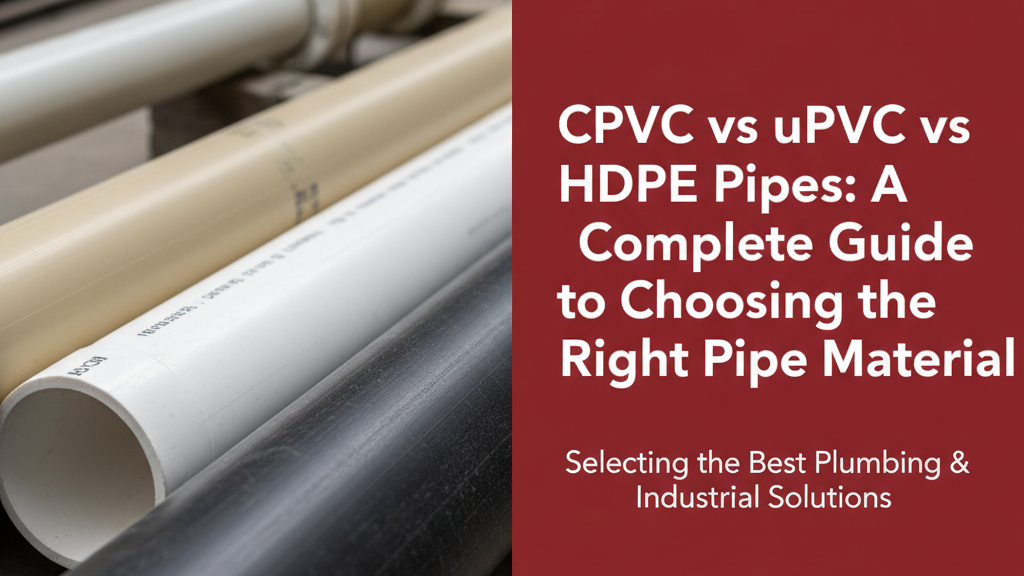
Here’s the reviewed and corrected HTML content:
“`html
Introduction to Pipe Materials
Selecting the right pipe material for plumbing, water supply, or industrial applications requires understanding how different plastics perform under varied conditions. In India’s challenging climate (high temperatures, monsoon rains, and seasonal temperature swings), CPVC, uPVC, and HDPE pipes each offer distinct advantages. This guide compares their properties, applications, and suitability.
What is CPVC Pipe?
Chlorinated Polyvinyl Chloride (CPVC) is a thermoplastic created by chlorinating PVC resin. This process enhances its temperature tolerance and chemical resistance compared to standard PVC. Key characteristics:
- Operational range: -0°C to 93°C (suitable for hot and cold water pipelines)
- Higher chlorine content provides inherent fire retardancy
- Rigid structure requiring fittings for directional changes
Advantages of CPVC Pipes
- Thermal stability: Maintains integrity at temperatures where standard PVC would soften (65-93°C range)
- Corrosion resistance: Resistant to acidic/alkaline water conditions common in industrial settings
- Smooth interiors: Low friction loss maintains water pressure over long distances
- Installation ease: Solvent cement joints cure rapidly without specialised equipment
Note: UV degradation can occur if exposed to direct sunlight for prolonged periods – recommend buried installation or protective layer
Common Uses of CPVC Pipes
- Residential/commercial hot water lines (replacing galvanised pipes)
- Chemical processing plants (handling acids in siphon lines)
- Fire sprinkler systems marked as UL-listed fire-resistant formulations
What is uPVC Pipe?
Unplasticised Polyvinyl Chloride (uPVC) omits the plasticisers used in flexible PVC, resulting in a rigid pipe with distinct applications:
- Working temperature range: 0-60°C (cold locations require insulation)
- Higher ring stiffness than CPVC for below-ground loading
- Less heat resistant than CPVC but more cost-friendly
Advantages of uPVC Pipes
- Weathering resistance: Superior to CPVC when exposed to UV/sunlight
- Cost-effectiveness: Typically 20-30% lower material cost versus CPVC for cold-water applications
- Hydraulic efficiency: Smooth bore minimizes bacterial biofilm accumulation
- Longevity: 50+ year service life when protected from mechanical damage as per ISO 4422
Common Uses of uPVC Pipes
- Municipal water supply mains (Schedule 40/80 pressure pipes)
- Drainage/waste vent (DWV) systems
- Irrigation and borewell riser pipes (depth-rated formulations)
What is HDPE Pipe?
High-Density Polyethylene (HDPE) is a flexible thermoplastic with exceptional toughness-to-weight characteristics:
- Temperature window: -40°C to 60°C (resistant to freeze damage)
- Joined by heat fusion (butt/electrofusion) creating leak-proof monolithic runs
- Exceptionally resistant to stress cracking in dynamic soils (like expansive clay)
Advantages of HDPE Pipes
- Flexibility: Can bend to radius (saves fitting costs)
- Trenchless installation: Works well with proper anchoring
- Corrosion immunity: Outperforms metals in saline/aggressive soils
- Lightweight: Density 0.93-0.97 g/cm³ makes rural transport easier
Common Uses of HDPE Pipes
- Slurry pipelines in mining (abrasion-resistant PE100 grades)
- Gas distribution networks (yellow stripe identification)
- Rural water ATMs and gravity-fed systems (low collapse risk)
Key Differences Between CPVC, uPVC, and HDPE Pipes
| Parameter | CPVC | uPVC | HDPE |
|---|---|---|---|
| Max Continuous Temp | 93°C | 60°C | 60°C |
| Impact Strength | Moderate | Brittle at low temperatures | High (cryogenic resistance) |
| Jointing Method | Solvent cement | Solvent/Rubber gasket | Thermal Fusion |
| UV Resistance | Poor (requires jacketing) | Excellent | Good (carbon black stabilised) |
| Pressure Rating | PN 10-25 | PN 6-16 | PN 6-25 |
Note: PN values denote nominal pressure ratings in Bar; Higher = thicker walls for series
How to Choose the Right Pipe Material for Your Project
- Temperature factors: CPVC when hot liquid is involved (>60°C)
- Exposure conditions: uPVC for long-term sun exposure applications
- Seismic activity: HDPE’s flexibility benefits in earthquake-prone zones
- Chemical compatibility: CPVC handles chlorinated water better than others
- Budget constraints: uPVC generally offers lowest initial CapEx

Conclusion: Making the Best Choice for Your Needs
No singular “best” plastic pipe exists—material selection hinges on temperature ranges, chemical environments, mechanical stresses, and installation constraints. CPVC dominates high-heat scenarios, uPVC excels in cost-sensitive cold-water infrastructure, while HDPE’s fusion-welded joints and flexibility prove ideal for dynamic environments. Consult IS 4985 (HDPE), IS 7834 (uPVC), and ASTM D2846 (CPVC) standards for detailed specifications.
“`