
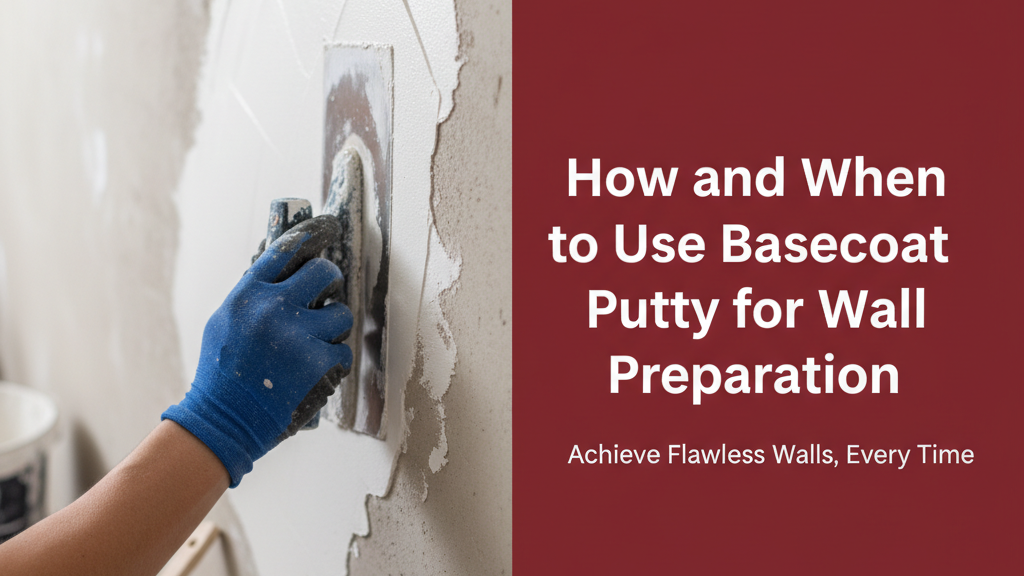
Introduction to Basecoat Putty
Basecoat putty forms the foundation of smooth, durable wall surfaces in Indian homes. Unlike finishing putties designed for final layers, basecoat variants are formulated with coarser particles to fill deeper imperfections while maintaining strong adhesion. This makes them particularly valuable for:
- Newly constructed walls with visible masonry joints or uneven surfaces
- Older walls showing cracks up to 3mm wide
- Concrete surfaces requiring sealing before painting
When properly applied, basecoat putty can extend paint lifespan by preventing moisture penetration and creating a stable substrate – especially important in humid regions like North Bengal.
When to Use Basecoat Putty
Recognising the right scenarios for basecoat application prevents unnecessary work and material waste:
- Fresh plaster: Mandatory for walls plastered within the last 28 days (curing period)
- Deep repairs: When filling cracks exceeding 1mm depth or unevenness over 2mm
- High-moisture areas: Bathrooms, kitchens, and exterior walls benefit from its moisture-resistant properties
- Before texture paints: Provides the necessary tooth for textured finishes
For minor blemishes on already smooth walls, a single coat of finishing putty may suffice.
How to Apply Basecoat Putty
Successful application hinges on surface preparation and technique:
- Surface cleaning: Remove dust, oil, or efflorescence with wire brush and damp cloth
- Moisture check: Walls should be dry (test with plastic sheet taped overnight – no condensation)
- Priming: Apply acrylic primer for porous surfaces; wait 4-6 hours before puttying
- Mixing: Blend powder and water to thick pancake batter consistency (avoids sagging)
- Application: Use stainless steel trowel at 45° angle; maintain 1.5-2mm thickness
Ambient conditions matter: avoid application during rains or temperatures above 35°C that accelerate drying.
Step-by-Step Application Guide
For professional-grade results:
- First coat: Apply vertically to fill major depressions; let dry 24 hours
- Sanding: Use 80-100 grit sandpaper to remove trowel marks
- Second coat: Apply horizontally with thinner layer (1mm); dry 24 hours
- Final sanding: Polish with 120-150 grit paper until palm glides smoothly
- Curing: Wait 48 hours before painting in humid climates
Choosing the Right Basecoat Putty
Key selection criteria for Indian conditions:
| Feature | Ideal for |
|---|---|
| White cement-based | High-strength bonding; exterior use |
| Polymer-modified | Crack bridging up to 3mm |
| Water-resistant | Bathrooms, coastal areas |
| Fine-grade (200+ mesh) | Smoother finish with less sanding |
Look for ISI-marked products meeting IS 15477 standards for cement-based putties.
Common Mistakes to Avoid
Frequent errors that compromise results:
- Over-thinning: Weakens structural integrity; maintain putty knife stand-up consistency
- Inadequate curing: Painting too soon traps moisture causing blistering
- Wrong trowel: Plastic tools leave streaks; stainless steel gives cleaner application
- Ignoring temperature: Below 10°C slows curing; above 35°C causes premature drying
- Skipping sanding: Creates visible ridges under paint
Tips for a Flawless Finish
Professional techniques for DIYers:
- Work in 3×3 foot sections for better control
- Use LED work lights at acute angles to spot imperfections
- Clean tools immediately with water before putty hardens
- Store leftover mix in airtight container for 2-hour usability
- For large areas, consider mechanical sanding with orbital sander
Conclusion
Proper basecoat putty application transforms wall preparation from a chore into a value-adding process. By selecting the right product for your wall type and climate, following systematic application steps, and avoiding common pitfalls, you create surfaces that enhance paint performance and longevity. The extra effort during preparation pays dividends through reduced maintenance and superior aesthetics over time.